
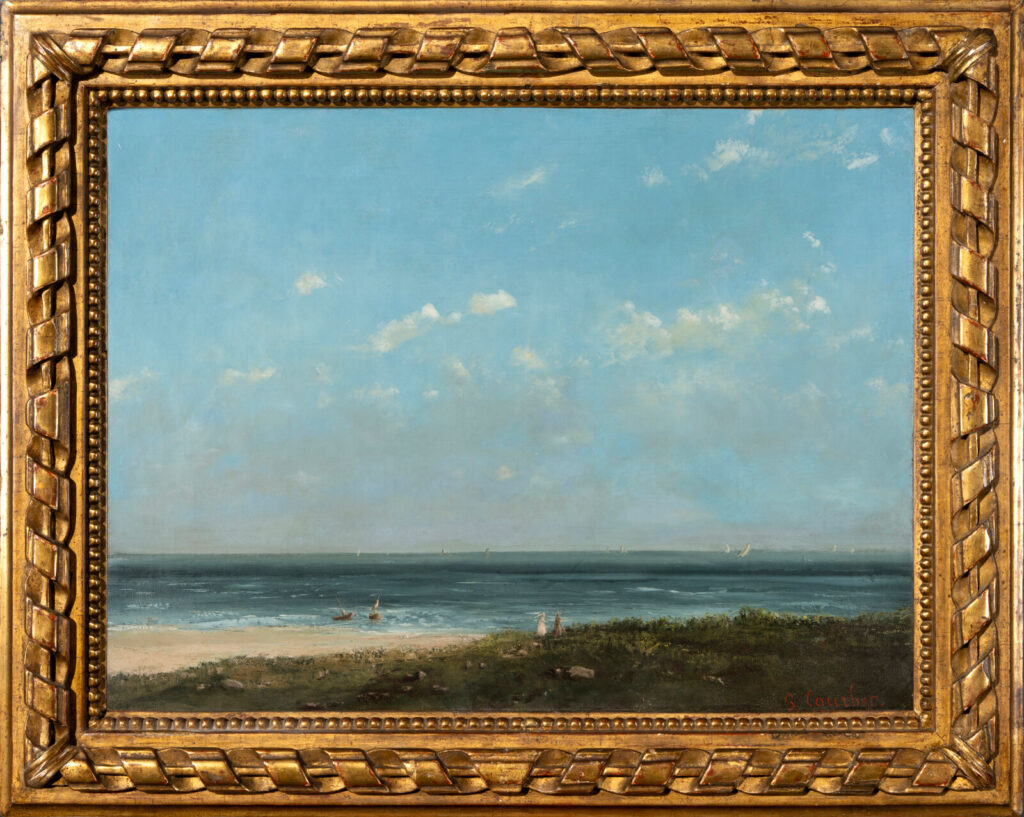
Lot 67
Gustave Courbet (1819-1877)
A Walk by the Sea, the Sailboats
Circa 1865–1869 · Signed oil on canvas · 18.1 × 24.0 in (46 × 61 cm)
€40,000–€60,000 · approx. USD 43,800–65,700
Indicative conversion at the ECB reference rate on 27 November 2026. Bidding is in euros.
Tuesday, 1 December 2026 · 2:00 pm French local time (1:00 pm GMT)
Count Eugène Biver and the arts in his family
Provenance: formerly in the collection of Count Biver at the Château de Villiers-le-Bâcle, then by descent.
Count Eugène Biver (1861–1929) was the son of Hector Biver, managing director and later a board member of Saint-Gobain. He entered the École Centrale at the top of his class and was an accomplished amateur photographer. His son Paul studied art history at the École du Louvre and became known for his books on French châteaux. His daughter Marie-Louise, a historian of art and architecture, wrote about town planning and Pierre Fontaine, Napoleon’s architect. The Musée Courbet in Ornans brought Biver’s and Courbet’s work together in an exhibition to which the Société française de photographie lent Biver’s photographs of rural life, a subject both artists shared. No direct connection between the two is known.
The Gustave Courbet Committee
The Committee approved the work in Paris on 5 October 2026. It will be included in the artist’s catalogue raisonné.
The Institut Gustave Courbet was founded in Ornans in 1939 by the painter Robert Fernier as Les Amis de Gustave Courbet. It preserves the artist’s legacy and promotes the study of his work. Its independent committee advises auction houses, museums, collectors and galleries on the attribution of paintings and drawings.
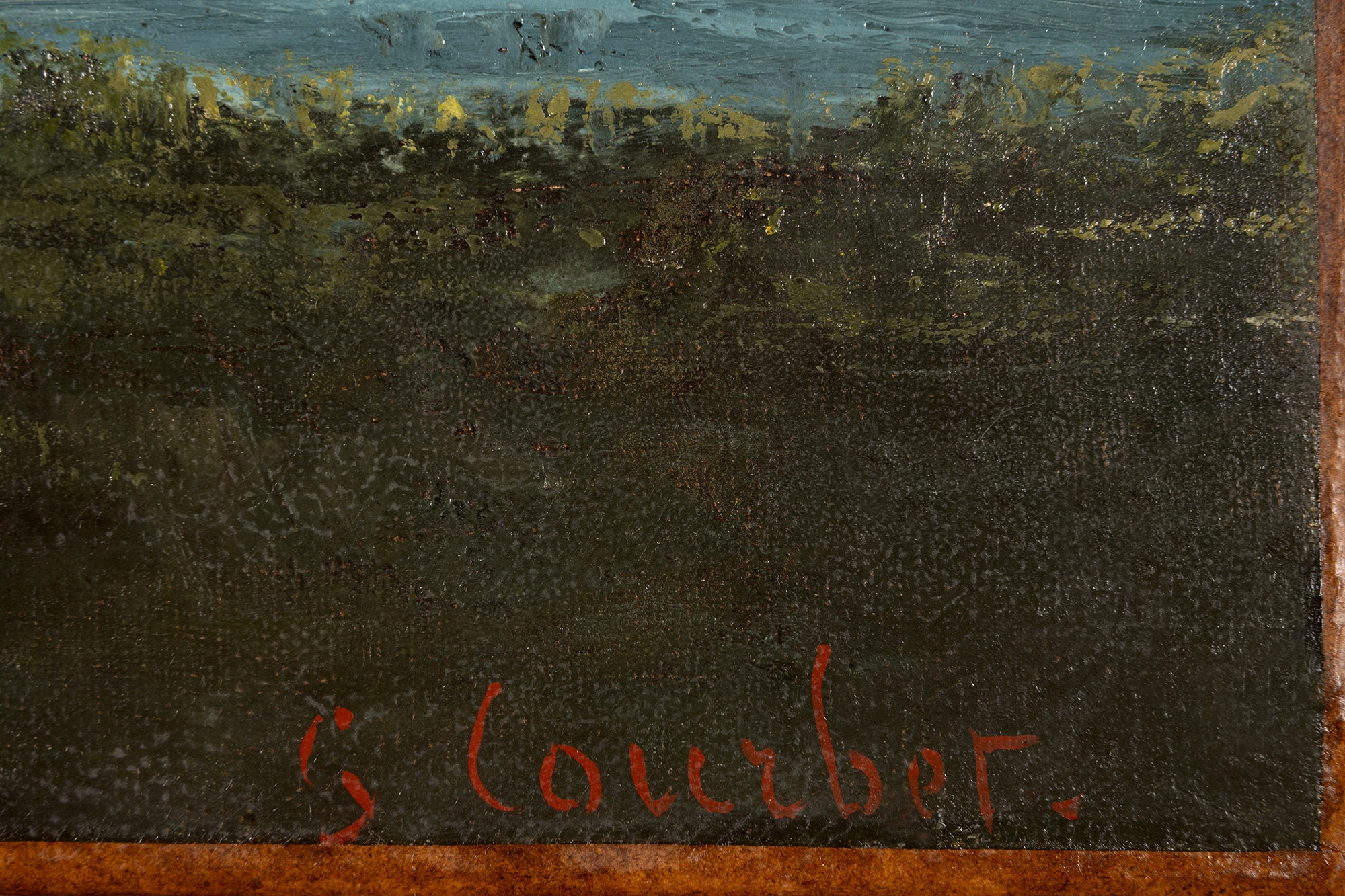
The Committee examines each work in person, including its stretcher, lining, inscriptions, signature, technique and provenance, before issuing an opinion. Comparable paintings from 1865 to 1869 are illustrated on pp. 36–44 of Robert Fernier’s La vie et l’œuvre de Gustave Courbet, vol. I, Fondation Wildenstein, Bibliothèque des Arts.
Seascapes in Courbet’s painting
Born in Ornans, among the rocky landscapes of Franche-Comté, Courbet was fascinated by water in all its forms. He first saw the sea at Le Havre in 1841 and returned regularly between 1859 and 1865. The encounter opened up a new field for experimentation: the sea offers none of the fixed landmarks of a mountain or forest landscape.
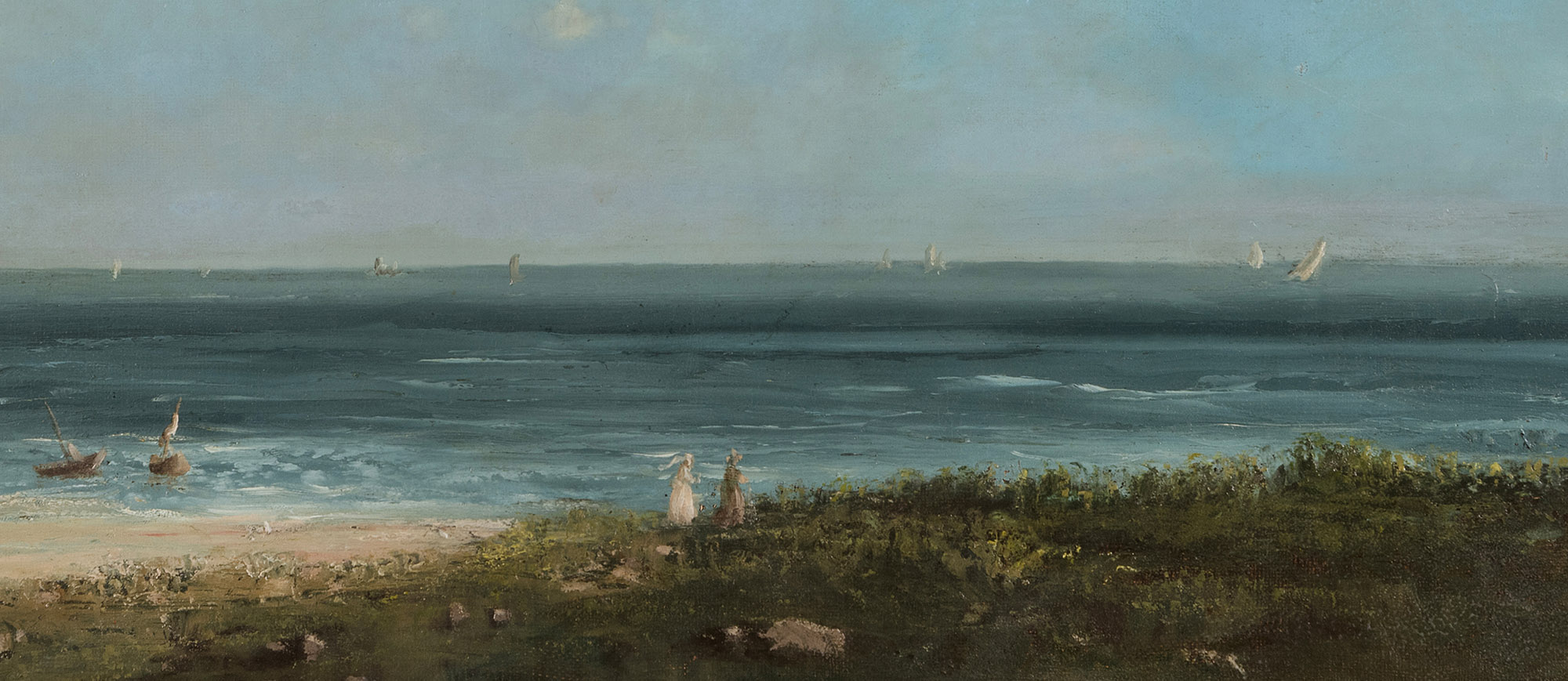
In this painting, as in other views of lively beaches, Courbet lowers the horizon until sky and atmosphere fill more than two-thirds of the canvas. The shore, dunes, boats and figures give the foreground a tactile quality. Beyond them the changing colours of the water, waves and foam lead the eye toward the expansive blue sky. Small figures under parasols and boats drawn up on the sand establish the scale of nature. This composition breaks with the academic conventions of perspective.
An art critic describes how Courbet discovered the sea in Boulogne, painted Mediterranean seascapes in 1854 and 1857, and explored the power of the waves at Trouville and Deauville from 1865. At Étretat in 1869, the monumental cliffs framed his efforts to capture the movement of tides and clouds. His attention to changing atmospheric light anticipated the Impressionists’ interest in fleeting effects.
“Beauty is in nature and appears in reality in the most diverse forms. Once found there, it belongs to art, or rather to the artist who knows how to see it. […] The beauty given by nature is above all the artist’s conventions.” — Gustave Courbet, translated from the French.
Gustave Courbet and the photography of Gustave Le Gray
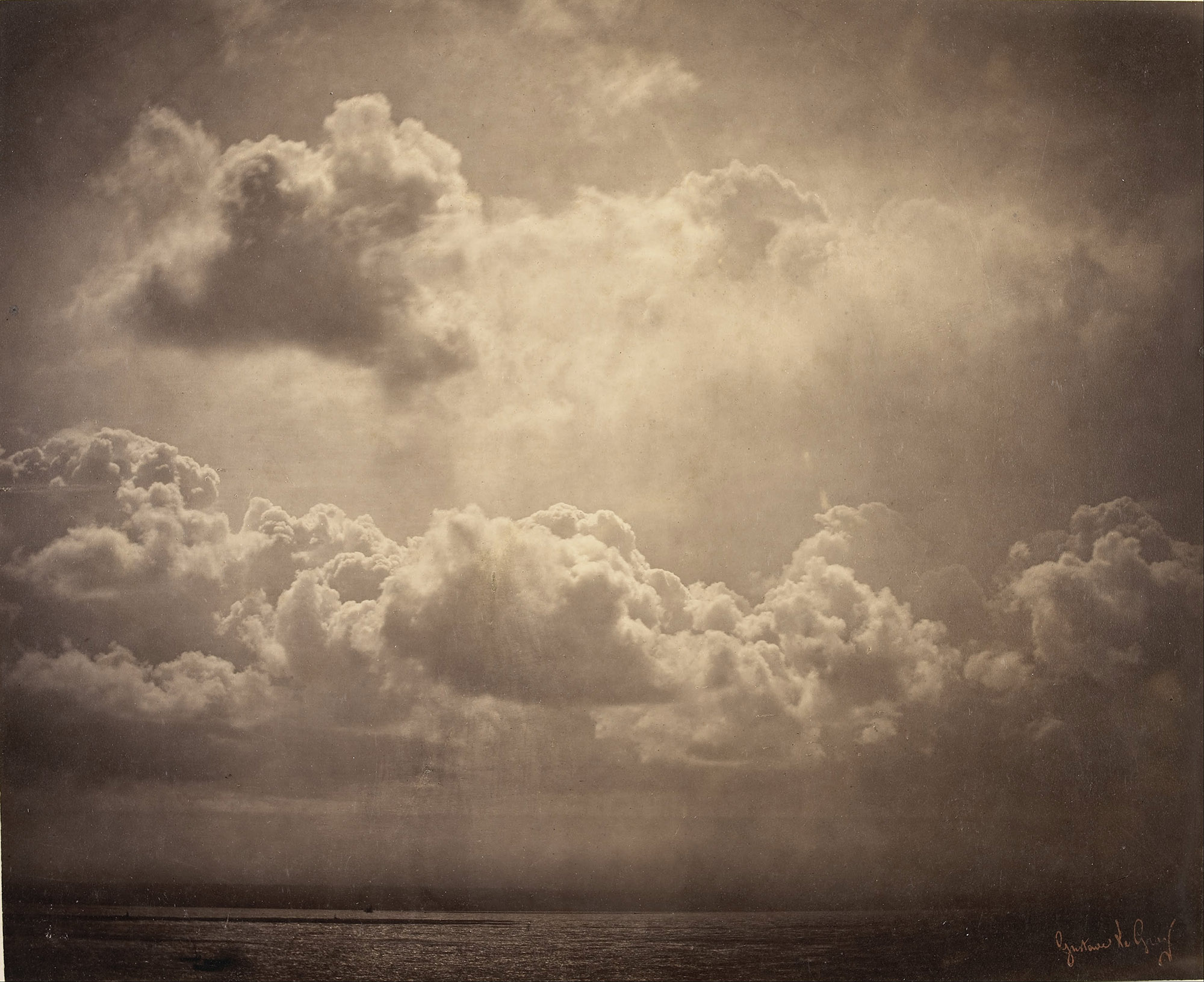
In Normandy, Courbet worked in the company of artists drawn to coastal light, including James Whistler and Eugène Boudin. Wide, frontal views link his work to Gustave Le Gray’s early marine photography. Their low horizons organise light, water and land into broad horizontal bands, as seen in Le Gray’s albumen prints of the 1850s.
Exposure posed a problem for early photographers: exposing for the sky could turn the sea and sand black, while exposing for land or water could leave the sky blank. Le Gray combined two negatives on one print, one for the sea and another for the clouds. This gave him dramatic skies above calm or rough water. The photographs circulated in Paris and were displayed in shop windows. The French account relates them to Courbet’s treatment of the sky as a mass shaped by light.
Selected references
- Dominique de Font-Réaulx, Peinture & Photographie. Les enjeux d’une rencontre, 1839–1914, Flammarion, 2020, pp. 126–130.
- Céline Flécheux, « La Vague. Courbet et la photographie », in L’Eau, les eaux, Jackie Pigeaud (dir.), Presses universitaires de Rennes, 2016, pp. 33–51.
- Sylvie Aubenas, Gustave Le Gray. 1820–1884, Bibliothèque nationale de France/Gallimard, 2002, pp. 243–246.
 Framed
 Unframed